When heart care comes closer to home
Published on 14 September 2026
Stable heart patients can now receive routine follow-up care closer to home through NUHCS’s Shared Care Programme, while remaining under the oversight of their specialist.
At a glance
- More than 380 stable cardiac patients have joined the programme since its launch in July 2024.
- Patients can save approximately 18 per cent on care costs through lower consultation fees when they receive long-term care at polyclinics or general practitioner (GP) clinics.
- Patients remain connected to NUHCS throughout. If their condition changes, they can be referred back directly for specialist assessment.
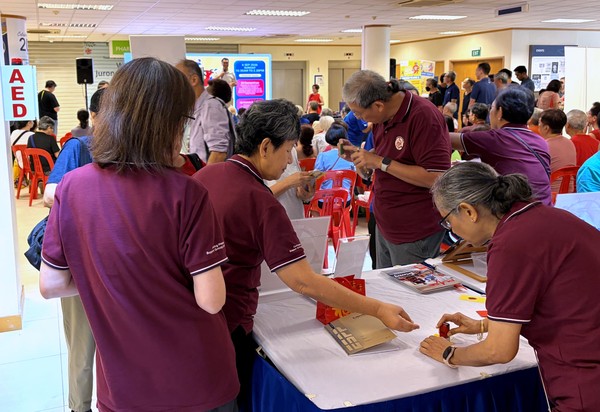
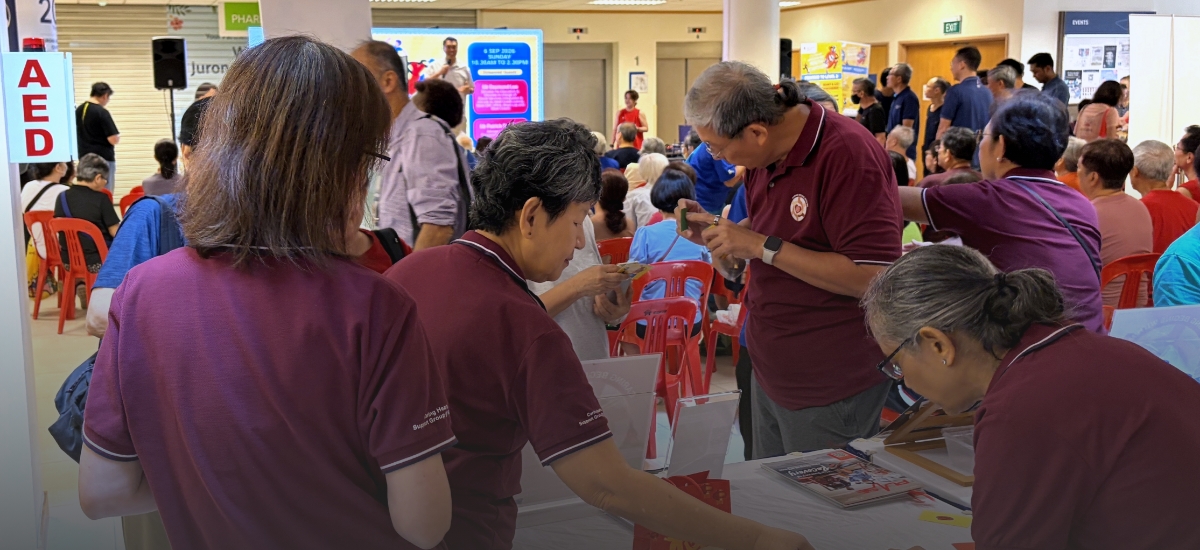
Heart support group volunteers welcoming residents at the NUHCS World Heart Health event, held at Jurong Medical Centre on 6 September 2026.
In 2018, Ms Theresa Yeoh felt bloated and unusually tired after a short walk at a Chinatown fair. With Chinese New Year just around the corner, she attributed it to the busy preparations.
"I never thought I could be having a heart issue," she recalled. "I just thought I needed to go home and rest."
The next day, she grew breathless and broke into a sweat on her way to a polyclinic. From there, she was rushed by ambulance to the National University Heart Centre, Singapore (NUHCS) where doctors confirmed that she was having a heart attack. She underwent an coronary angiogram and angioplasty, and had a stent implanted.
Today, more than eight years on, Ms Yeoh is active again. She hikes, swims and practises qigong about four times a week, and enjoys spending time with her five grandchildren.
What has changed is not only her health, but also where she receives her care. Since 2024, her routine heart checks have taken place closer to home through the NUHCS Shared Care Programme.
Longer wait times at the clinics
Before the programme, patients with stable heart conditions found themselves having to choose between travelling to a specialist clinic or transferring their care entirely to a primary care provider, such as a family physician or pharmacist at a polyclinic, said Adj A/Prof Lim Toon Wei, Head of Community and Preventive Cardiology, NUHCS, and the programme’s clinical lead.
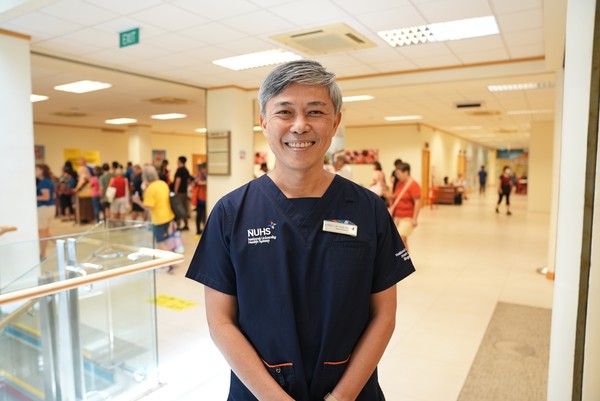
Adj A/Prof Lim Toon Wei, clinical lead of the NUHCS Shared Care Programme, at the NUHCS World Heart Health event at Jurong Medical Centre.
For some, staying with the specialist provided reassurance, particularly if they were concerned about accessing specialist care when they needed it. Others transitioned their care completely to a primary care provider, but sometimes cardiovascular risk factors might not be managed as closely.
This meant specialist clinics continued to see many patients with stable conditions. “Our clinics were so overwhelmed with stable patients that wait times kept getting longer,” Adj A/Prof Lim explained.
Patients who need only a minor medication adjustment may still have to wait three to four months for a specialist appointment. Yet for many clinically stable patients, routine follow-up could be delivered more conveniently closer to home without compromising care.
How the Shared Care Programme works
Launched in July 2024, the Shared Care Programme allows stable heart patients to receive routine follow-up at a nearby polyclinic or GP, while continuing their annual review with their NUHCS specialist.
More importantly, these patients are not discharged from NUHCS. If any concern arises, a care coordinator can arrange for an early appointment with their usual cardiologist at the specialist clinic.
Staying aligned on a patient's condition
When a patient joins the programme, their cardiologist sends their primary care provider a letter outlining their targets for blood pressure, cholesterol and blood sugar, together with details of their medications.
“In the past we didn’t have a standardised way of communicating,” said Adj A/Prof Lim. “Now, everyone’s on the same page.”
The two teams also stay connected through chat groups, where primary care providers can share an electrocardiogram (ECG) reading or medication query and receive a prompt response from the specialist. This helps the patient to receive the right care at the right place, while freeing specialist appointments for more complex or less stable patients who need them.
Is NUHCS's Shared Care Programme suitable for you? Your NUHCS specialist will assess whether shared care is suitable based on a set of criteria. Generally, you should:
Suitability for shared care is assessed on a case-by-case basis. Patients remain under the care of NUHCS and can be referred back to their specialist at any time if their condition changes. |
Staying connected to specialist care
For Ms Yeoh, the programme has made routine care more convenient. “Distance-wise, it's much easier,” she explained, elaborating that she travels down to a polyclinic near her home. “I can take just a few months' worth of medication and go more often.”
She was glad to sign up. A polyclinic doctor now reviews her regularly, alongside her yearly specialist visit.
Having direct access to her specialist provided Ms Yeoh with peace of mind. In October 2024, when she developed chest and jaw pain, her polyclinic doctor promptly arranged an ECG. Although the results were normal, her doctor continued to check in on her regularly.
Subsequent investigations were reassuring and showed no serious abnormalities, allowing her to remain confident and well supported by her care team.
Why closer care can mean better numbers
Many stable heart patients can be cared for in the community, said Adj A/Prof Lim, including those with more complex conditions such as heart failure.
With appropriate medication, people who have had a heart attack can often remain stable for years. “Even if you’ve had one heart attack, we can prevent the next one,” he shared.
More touchpoints in the community also mean opportunities to monitor and manage cardiovascular risk factors. “They get reminded, or ‘nagged,’ more often. We can adjust their medications more frequently, if need be,” said Adj A/Prof Lim.
Better numbers, closer to home
NUHCS compared patients’ health markers in the year before and after they joined. The results were promising.
A year on, their cardiovascular risk factors remained stable or improved. Average blood pressure was 132 mmHg, close to the target of below 130 mmHg, while blood sugar remained steady and cholesterol levels improved.
More convenient and affordable
Care also became more affordable, with patients paying about 18 per cent less on average due to lower consultation fees at community clinics.
For older patients, having care closer to home can make a meaningful difference. Instead of travelling to hospital and relying on a family member to accompany them, a nearby polyclinic made it easier to attend appointments independently.
“If the clinic is just across the road, older patients are more likely to go on their own,” said Adj A/Prof Lim.
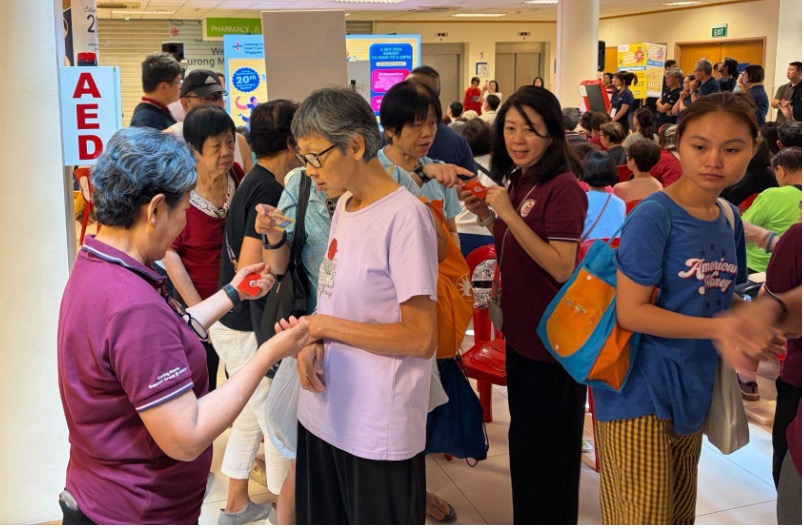
Support group volunteers helping residents at a booth during the event, part of NUHCS's wider push to bring heart health into the community.
More than 380 stable patients have joined the programme since its inception. NUHCS has also extended the programme to its heart clinic at Ng Teng Fong General Hospital (NTFGH).
Building confidence in shared care
For some patients, moving routine care into the community can take time and reassurance. One misconception Adj A/Prof Lim hopes to address is the belief that a family physician “isn’t able to do most of it, if not all of it”. With the right support, he said, primary care providers can manage most routine heart care, while specialists remain available when their expertise is needed.
Ms Yeoh's experience has given her confidence in the shared care approach. “For a heart patient, sometimes you may still feel very fatigued or notice some symptoms. So, it's good that these doctors can monitor our condition,” she said.
For her, it offers the best of both worlds: convenient follow-up closer to home, while staying connected to her specialist team at NUHCS.
In consultation with Adj A/Prof Lim Toon Wei, Head of Community and Preventive Cardiology, and Senior Consultant, Department of Cardiology, NUHCS.
Related Articles