When eye problems are more than they seem
Published on 28 October 2026
Watery eyes can signal more than irritation, while serious inflammation may go unnoticed. New approaches are making treatment more targeted and coordinated.
A watery eye may seem like a minor nuisance, while a serious eye condition may develop without any obvious symptoms. What you feel, or do not feel, does not always reflect what is happening beneath the surface.
At National University Hospital (NUH), new approaches are helping doctors address these problems, from using a fine endoscope to unblock tear ducts to bringing eye and rheumatology specialists together in one consultation.
When watery eyes are more than just dry eyes
For months, Ms Irene Tan, 59, thought her watery right eye was caused by dry eyes. Warm compresses, eyelid wipes and reduced screen time did little to help. The persistent tearing and sticky discharge irritated her skin and delayed her planned cataract surgery.
When eye drops and gel also failed to relieve her symptoms, Dr Maryanne Chew Romero, Consultant, Department of Ophthalmology at NUH, suspected that a blockage in Ms Tan’s tear drainage system was contributing to her symptoms.
A blocked tear duct is a common cause of persistent tearing, but many patients do not recognise the signs, Dr Romero said. Normally, tears drain through tiny channels at the inner corner of the eye. When these channels narrow or become blocked, tears accumulate, causing persistent watering and sometimes sticky discharge or recurrent infections. Lubricating eye drops cannot resolve the underlying blockage.
“Many of our patients live with persistent tearing for months or even years, seeking help only when it becomes unbearable or leads to a serious infection,” Dr Romero added.
To clear the blockage, Dr Romero recommended a less invasive outpatient procedure – dacryoendoscopy-guided ELDR. Although initially nervous, Ms Tan was reassured by the care team’s support throughout the procedure. “The nurse held my hands, and Dr Romero would explain what she was going to do before each step, so I knew what to expect. That really helped me to relax,” she said.
The procedure took less than an hour, with little to no downtime, and Ms Tan’s persistent tearing and discharge resolved. She is now waiting for her condition to stabilise before proceeding with cataract surgery.
A less invasive way to unblock tear ducts
While some patients dismiss persistent tearing as dry eyes, others put off treatment because they fear surgery and a lengthy recovery.
Ms Sharon Lee experienced both concerns. For over a year, her watery left eye disrupted her work, but she was reluctant to undergo surgery after witnessing her mother’s complications and prolonged recovery following traditional tear duct surgery.
How ELDR restores the flow of tears
Traditional surgery to treat a blocked tear duct can involve creating a new drainage pathway through the bone between the eye and nose. For patients like Ms Lee, the prospect of such an operation can be daunting.
Referred to NUH by her mother’s physician, Ms Lee learnt that she was also suitable for dacryoendoscopy with Endoluminal Lacrimal Duct Recanalisation (ELDR), the same outpatient procedure that had helped Ms Tan. After undergoing ELDR in July 2026, Ms Lee’s tearing stopped completely.
“Having seen what my mother went through, I was concerned about undergoing surgery myself. But the constant tearing was already affecting my work and daily life. I am very grateful that there was another treatment option available,” she shared.
Unlike traditional surgery, ELDR does not require cutting through bone. Instead, a fine endoscope less than a millimetre wide is guided through the natural tear duct to clear the blockage and restore normal tear drainage.
“By broadening the treatment options available, we can tailor the approach for each individual rather than offering everyone the same treatment,” Dr Romero explained.
NUH first introduced dacryoendoscopy-guided ELDR in 2015 and adopted a newer, more flexible endoscope in 2023, enabling suitable patients to undergo the procedure on an outpatient basis with minimal anaesthesia. More than 50 patients have undergone the outpatient procedure since 2023. Compared with conventional surgery, it causes less surgical trauma and offers suitable patients a faster recovery.
When eye inflammation goes unnoticed
While persistent tearing can be difficult to ignore, some eye conditions may develop with few or no noticeable symptoms. Uveitis is one of them.
Mdm Sally Chia’s son learnt that he had eye inflammation during his pre-enlistment medical screening for National Service. Despite having no eye pain, blurred vision or noticeable symptoms, routine checks detected inflammation inside his eye. He was subsequently referred to NUH, where he was enrolled in the Eye and Rheumatology in Adults (ERA) Combined Clinic.
Uveitis can cause redness, pain, light sensitivity or blurred vision, but some patients may have no noticeable symptoms. Without timely treatment, it can lead to complications such as glaucoma and irreversible vision loss. In some patients, severe or recurrent uveitis may be associated with underlying autoimmune or rheumatological conditions.
Since starting treatment at NUH in 2025, Mdm Chia’s son has undergone different treatments to control the inflammation, including oral medication, self-administered injections and infusions, with treatment adjusted according to his response. As he had no pain or vision problems, however, understanding why he needed ongoing treatment was not always easy.
Getting two specialists in one visit
Managing complex uveitis can involve regular visits to both ophthalmologists and rheumatologists. Previously, patients might need to attend separate appointments on different days, with up to three consultations if complications such as glaucoma were involved. Coordinating care across specialties could also mean waiting longer for treatment decisions.
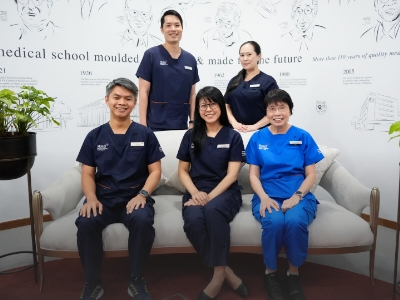
For Mdm Chia, who juggled work with caring for her son and father-in-law, these visits added to an already busy schedule. NUH’s Eye and Rheumatology in Adults (ERA) Combined Clinic has eased the burden by bringing both specialists together in a single appointment.
The joint consultation allows doctors to assess disease activity and adjust treatment plans together, rather than having patients wait for recommendations from separate appointments.
“Rather than navigating multiple appointments and receiving treatment recommendations days later, patients are now able to benefit from coordinated specialist input within a single visit,” said Dr Dawn Lim Ka-Ann, Senior Consultant and Head of the Ocular Immunology Service, Department of Ophthalmology, NUH, and co-lead of the clinic.
Making long-term treatment easier to manage
Coordinated care also helps patients manage long-term treatment safely between appointments, from taking medication correctly to learning how to administer injections at home.
“Patients require education, vaccination, laboratory monitoring and ongoing support to ensure treatment remains both effective and safe,” said Adj A/Prof Manjari Lahiri, Senior Consultant, Division of Rheumatology and Allergy, Department of Medicine, NUH, and co-lead of the clinic.
|
What support is available during treatment? At NUH’s ERA Combined Clinic, nurses and pharmacists help patients and caregivers manage ongoing treatment through:
|
With this support integrated into their care, patients and caregivers can better understand their treatment, know what to do between visits and manage it more confidently at home.
In consultation with Adj A/Prof Manjari Lahiri, Senior Consultant, Division of Rheumatology and Allergy, Department of Medicine, NUH; Dr Dawn Lim Ka-Ann, Senior Consultant and Head of Ocular Immunology Service, Department of Ophthalmology, NUH; and Dr Maryanne Chew Romero, Consultant, Department of Ophthalmology, NUH.
Related Articles