Rebuilding lives after trauma injuries
Published on 28 June 2026
In their darkest hour, the multidisciplinary team works quickly and seamlessly to give these patients with trauma injuries a fighting chance.
At a glance
- In 2025, NUH treated 28,487 trauma patients, managing one of the highest volumes of patients with severe injuries.
- Among them, about 1,200 patients with moderate to severe injuries were managed by NUH’s National University Centre for Trauma.
- Under pre‑hospital diversion protocols for complex injuries, particularly in Singapore’s Western region, critically injured patients are diverted to NUH.
Mr Patrick Pereira, 55, distinctly remembers 10 September 2017, the day a lorry slammed into him, while he was riding his motorcycle.
The collision resulted in massive blood loss, the loss of his spleen and gallbladder, and nine surgeries to repair the physical trauma.
As Mr Pereira entered the yellow box at the T-junction, a lorry turned right and collided into him. The driver had been looking to his left when he turned right, not noticing Mr Pereira. “I flew off my motorcycle and my helmet hit the lorry’s windscreen,” he recalled. “The impact was so great that my arms and pelvis were fractured.”
“Later on, I learned from the doctors that I might not have survived if I had arrived at the emergency department any later.”
The golden hour
Fortunately, an ambulance arrived within five minutes, and Mr Pereira was rushed to the Emergency Department at the National University Hospital (NUH), where Dr Zulkarnain Ab Hamid, Senior Consultant, Emergency Medicine Department, NUH, and his team were already on standby, having received an alert from the Singapore Civil Defence Force.
“Mr Pereira came in past 6pm, and he was actually quite alert then,” Dr Zulkarnain recalled. “However, his blood pressure was very low, which was quite concerning. In the context of trauma, every second counts — mortality can be very high for patients if we do not get things done early to bring up blood pressure.”
Mr Pereira’s low blood pressure indicated an active source of bleeding in the body, which could have been catastrophic. “The first thing that comes to mind when a patient presents with hypotension after sustaining trauma is the ‘X’, which stands for exsanguinating haemorrhage,” Dr Zulkarnain explained. “This rapid bleeding can potentially kill the patient immediately.”
Within the next 10 minutes, Dr Zulkarnain and his team worked rapidly to set an intravenous catheter in Mr Pereira’s leg, as well as an IO (intraosseous) needle into his bone to infuse fluids and medications quickly to bring up his blood pressure.
They also applied a binder to stabilise Mr Pereira’s pelvic fracture, which improved his blood pressure. “We wanted to send Mr Pereira for a CT (computed tomography) scan, which would enable the surgeons to identify internal injuries before he was taken to the operating theatre,” Dr Zulkarnain explained. “Unfortunately, his blood pressure tanked again when we brought him to the CT scan room.”
“Together with the multidisciplinary team, we made a rapid decision to forgo the CT scan, transfused more blood, and rushed him up to the operating theatre, where the surgeons and anaesthetist took over.”
Mapping the road ahead
While speed is critical in trauma surgeries, seamless coordination between disciplines is even more vital. As Mr Pereira had a multitude of severe injuries, the multidisciplinary team needed to make a crucial call on prioritisation.
“We called upon a senior orthopaedic surgeon, and after discussion, we decided that the trauma surgeons would go first in the operating theatre,” explained Dr Lynette Loo, Head of Division & Senior Consultant, Division of General Surgery (Trauma), Department of Surgery, NUH, who was one of the trauma surgeons involved in Mr Pereira’s care.
The trauma surgeons discovered a tear in a major blood vessel supplying the liver, causing Mr Pereira to bleed massively into his abdomen. He also had serious injuries to the diaphragm, liver and spleen, which was removed.
“As trained general surgeons, we do what is necessary first to buy time and temporarily stop the bleeding,” Dr Loo said. “We packed the pelvis to tamponade the bleeding, and the orthopaedic surgeon placed a metal plate to fix the pelvic fracture.”
“Due to the urgency of the situation, we could not close the abdominal incision. A temporary dressing was placed for Mr Pereira, and he was brought back to the intensive care unit, so that we could reassess the situation again the next day.”
A second surgery was scheduled the next day, where Dr Loo and the liver surgeons successfully repaired the torn blood vessel, bile tubes and diaphragm, and removed the gallbladder, which was badly injured in the accident.
Once Mr Pereira was stable, further procedures were done to close the abdomen and repair other fractures in his body.
A gameplan for recovery
This was the start of Mr Pereira’s long and arduous journey towards recovery, where he spent two months in NUH, including 10 days in the intensive care unit. “There was a large team of healthcare professionals working on me, in the operating theatre and in the ward,” Mr Pereira recalled. “The nurses were fantastic and patient, as I was in so much pain.”
He had to relearn simple activities of daily living, including getting around. “I had titanium rods implanted into my pelvis, and the physiotherapists guided me to learn to sit on a wheelchair to move around,” he said. “I was screaming in pain.”
“Once Mr Pereira was ready, our first aim was to get him out of bed,” explained Ms Karilyn Koh, Senior Physiotherapist, Department of Rehabilitation, NUH. “But we faced a lot of barriers, including intense pain and movement restrictions to protect the healing structures within the body.”
“At the same time, we have to manage the emotional trauma these patients are going through, from being in pain every day and losing the ability to do simple tasks, like sitting upright.”
Ms Koh and her team worked patiently with Mr Pereira to mentally prepare him for each physiotherapy session. Three weeks after the accident, he was finally able to leave the confines of the hospital briefly for some fresh air and sunshine.
The impact of the accident also severed the nerves in Mr Pereira’s left arm, leaving him with a drop wrist and loss of range of motion in his fingers.
“I had some of the best doctors attending to me, including Adj Asst Prof Raj Menon (Centre Director, National University Centre for Trauma, NUH) and Adj A/Prof Sandeep Jacob Sebastin Muttath (Head & Senior Consultant, Department of Hand & Reconstructive Microsurgery, NUH),” he said. “Adj A/Prof Sebastin performed a nerve graft on my arm, using nerves harvested from my left calf, which restored some function in my hand.”
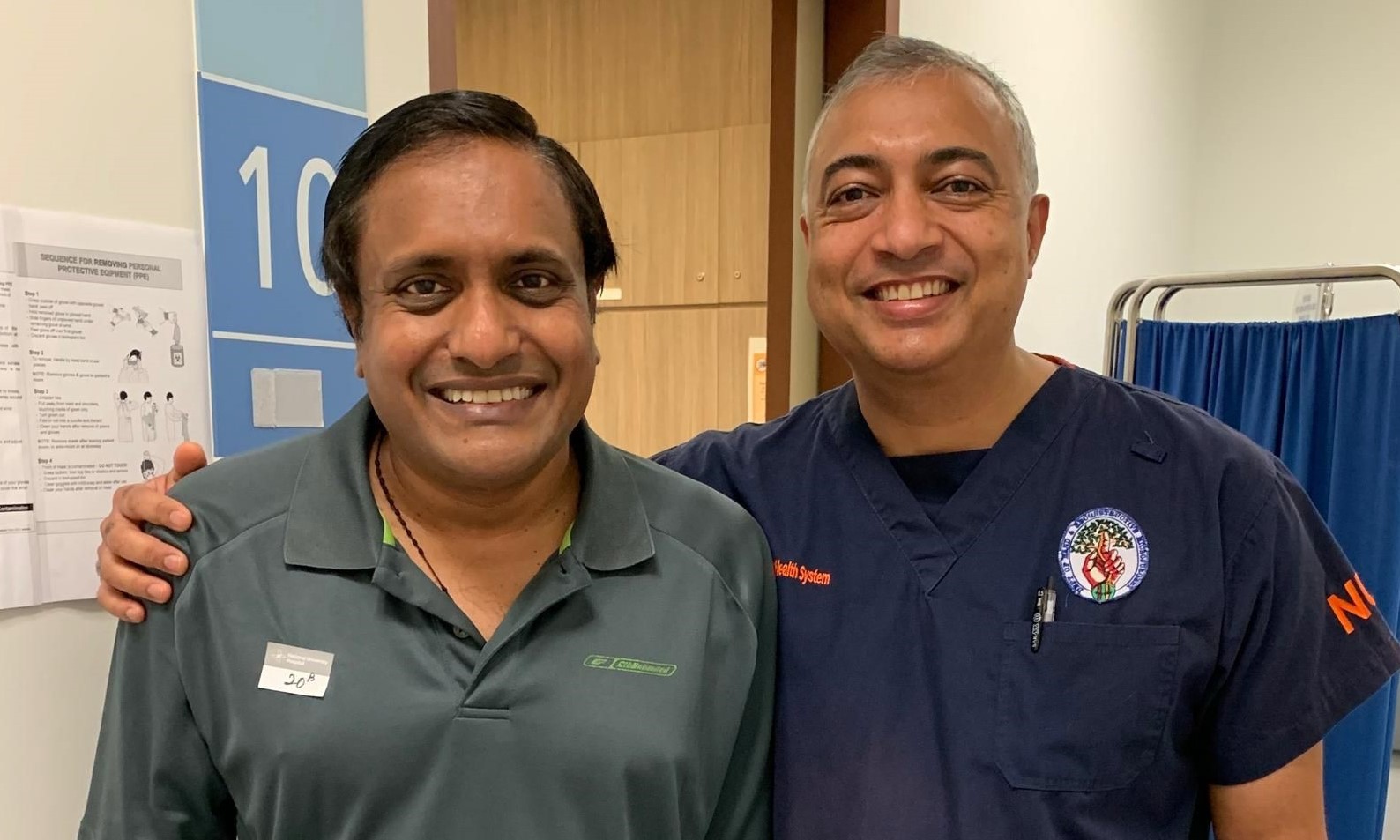
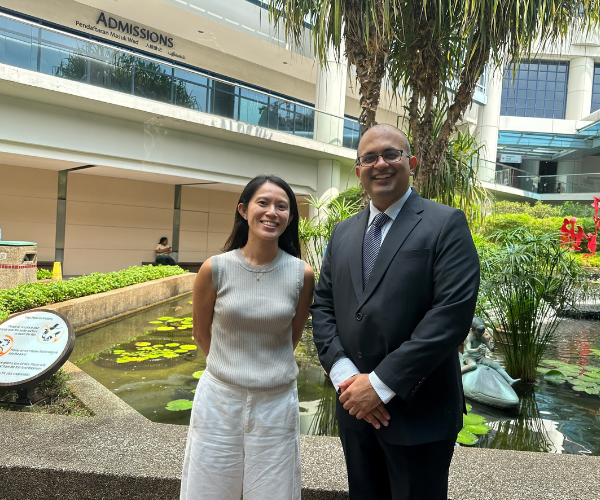
Mr Pereira and Adj A/Prof Sebastin, who performed a complex nerve surgery on his left arm.
“When the orthopaedic surgeons went in to fix the fracture on Mr Pereira’s left arm, they found that the radial nerve was contused, which was causing the wrist and finger drop,” explained Adj A/Prof Sebastin. “We scheduled a surgery about three months after the accident, to remove the unhealthy segment of the nerve.”
“This left a 10cm gap, and we took a 40cm length of nerve from his leg, divided it into four cables and transferred it into his arm.”
The delicate nerve surgery enabled Mr Pereira, an avid aviator, to regain significant function in his left hand, allowing him to type and manoeuvre his drone controller again.
Lingering aftermath of trauma
For years after the collision, Mr Pereira would experience intense flashbacks and chills whenever he passed the site of the accident.
“The accident happened on a small road near my house that I had to pass by every day,” he said. “It affected me massively psychologically, long after the physical wounds had healed.”
He joined the National University Centre for Trauma’s trauma survivor support group in 2023, an initiative dedicated to providing trauma survivors with resources to return to their lives and a sense of community.
Beyond emergency and surgical care, the National University Centre for Trauma supports trauma survivors in their recovery journey, including Singapore’s first trauma survivor support group, which focuses on survivorship, rehabilitation, and psychosocial recovery to help patients rebuild their lives after serious injury.
“Being part of this group really helps – some trauma survivors don’t look different physically, but only we understand the deficiencies we carry with us,” Mr Pereira, who now works in IT operations, said. “One of the sessions involved art jamming, which I enjoyed.”
For Mr Pereira, life has changed irrevocably, as a result of unsafe road behaviours. He hopes that road users can be more vigilant on the road, and that more support can be provided for trauma survivors. “I hope there can be more support and guidance for victims – trauma not only affects individuals, but also their loved ones,” he shared.
In consultation with Dr Lynette Loo, Head of Division & Senior Consultant, Division of General Surgery (Trauma), Department of Surgery, NUH; Adj A/Prof Sandeep Jacob Sebastin Muttath, Head & Senior Consultant, Department of Hand & Reconstructive Microsurgery, NUH; Adj Asst Prof Raj Menon, Centre Director, National University Centre for Trauma, NUH, and Ms Karilyn Koh, Senior Physiotherapist, Department of Rehabilitation, NUH.
Related Articles