How three emergency physicians turned a mid-flight crisis into a life saved
Published on 23 April 2026
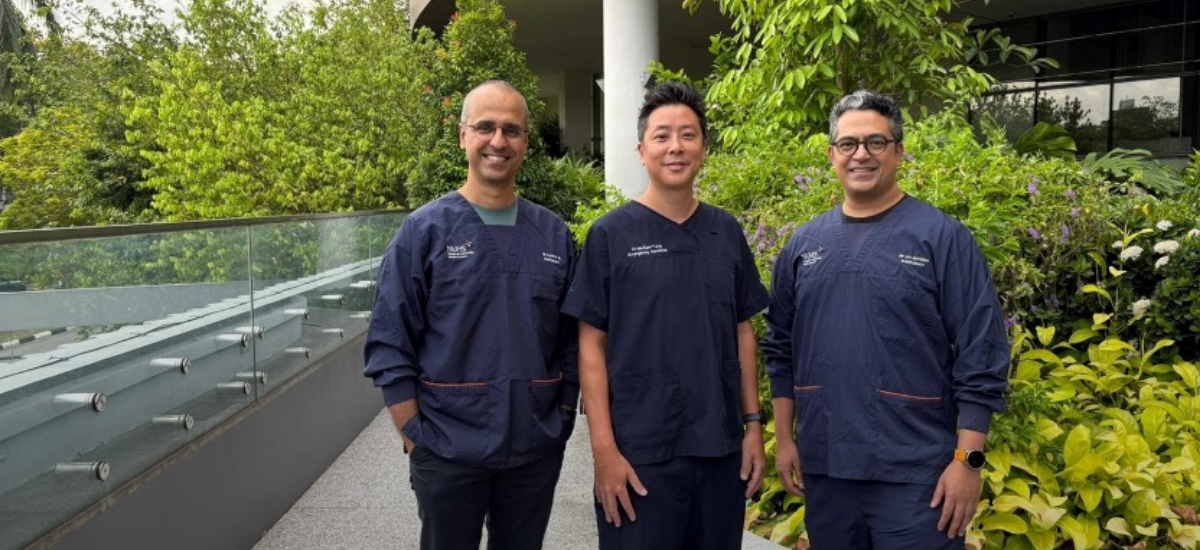
When a passenger went into cardiac arrest mid-flight, three emergency physicians, including two from National University Hospital (NUH), stepped in to save a life.
At a glance
- A passenger suffered cardiac arrest mid-flight and required immediate resuscitation
- Three emergency physicians on board, including two from NUH, performed prolonged CPR on the passenger
- The early intervention saved his life, underscoring the critical role of emergency physicians in life-threatening situations
It was meant to be a routine overnight flight from Singapore to Sydney, Australia, with cabin lights dimmed and most passengers settling in for the journey ahead.
Then, without warning, the calm was broken by a woman’s cries ringing out across the cabin.
It turned out her husband had suddenly slumped in his seat and was rapidly losing consciousness. It quickly became clear that this was a life-threatening emergency.
The commotion immediately caught the attention of two other passengers on board the flight who were seated nearby – Adj Asst Prof Kanwar Sudhir Lather and Adj Asst Prof Ian Mathews, who were both Senior Consultants from the Emergency Medicine Department at National University Hospital (NUH).
For the two of them, years of training and experience took over in an instant, as they stepped out of their seats to render medical assistance.
“We were dealing with a cardiac arrest,” Adj Asst Prof Mathews said. “For all intents and purposes, if nothing was done, he would have died.”
A race against time
As the patient’s condition deteriorated, his breathing became shallow, and soon after, his heart stopped.
In a hospital, such a situation would activate a full emergency response team equipped with monitors, medications, and other support systems. On a plane at cruising altitude, however, Adj Asst Prof Kanwar and Adj Asst Prof Mathews had to make do with the cabin as an improvised treatment space.
There was limited room to move, only basic medical equipment, and no access to the full range of hospital resources.
But with a life on the line and time being critical, they adapted quickly and began administering treatment.
“We started cardiopulmonary resuscitation (CPR) on him and gave instructions to the flight crew to get the automated external defibrillator (AED),” Adj Asst Prof Lather recalled. “In situations like this, you don’t wait. You act. Responding to life-threatening situations is part of the core training in emergency medicine.”
Adj Asst Prof Mathews added, “We were dealing with limited manpower and resources. But that’s part of our training, the ability to react with limited information and in critical situations.”
The aircraft crew also played a vital role, retrieving oxygen, medications, and a defibrillator while assisting with whatever was needed. Around them, passengers shifted to make space, aware that something serious was unfolding.
Despite the unfamiliar surroundings and intensity of the situation, coordination came naturally to the two doctors, who have often worked alongside each other in the Emergency Department at NUH.
“There’s a lot of non-verbal communication,” Adj Asst Prof Mathews explained. “We know exactly what needs to be done, so no two people are doing the same thing.”
Holding the line for 45 minutes
Resuscitation continued for close to 45 minutes, with the patient’s condition fluctuating throughout. By then, Dr Michael Fung, a Senior Consultant in Acute and Emergency Care at Khoo Teck Puat Hospital who had travelled with them, had also joined in to assist during the resuscitation.
Eventually, the patient’s heart rhythm returned briefly, only to falter again, before gradually stabilising.
“He started breathing on his own again,” Adj Asst Prof Mathews said. “His heart rhythm became more stable, although he was still unwell.”
That, however, was only the beginning of the next phase. For several hours after, the three doctors remained by his side, monitoring him closely and adjusting care as needed while the plane continued its journey.
Decisions beyond clinical care
Even after the patient stabilised, his condition was fragile, and the risk of deterioration was still very real.
“There were still five hours left in the flight when it started,” Adj Asst Prof Lather said. “We advised diversion because we judged that he needed hospital care as soon as possible.”
The aircraft eventually made an unscheduled landing at Adelaide Airport, where paramedics boarded promptly and took over care of the patient.
Calm in the midst of pressure
To others on board, the scene may have appeared tense and overwhelming. For the doctors, however, their focus remained firmly on the task at hand.
“The initial focus is always on the patient,” Adj Asst Prof Mathews said. “Every other distraction gets blocked out.”
Maintaining composure was essential, not only for decision-making but also for those assisting them.
“If the leader is frantic, the team becomes frantic,” he added. “But when you remain calm with a sense of urgency, the team responds in the same way.”
In the days that followed, the three doctors reflected on the experience and what it revealed about the impact of their work.
“It gives us a refreshed perspective on emergency medicine,” said Adj Asst Prof Mathews. “What we do can make a difference, even outside the hospital.”
For Adj Asst Prof Kanwar, the takeaway was just as clear.
“It reminds us why we do what we do,” he said. “When it matters most, being able to act and save a life, that is the value of this specialty.”
When every second counts, everyone can help
Beyond the immediate rescue, the experience also highlighted a broader message for the public. In cardiac emergencies, the first few minutes are often the most critical, and bystanders can play a decisive role before professional help arrives.
As such, Adj Asst Prof Lather encouraged members of the public to step forward when it matters.
“Even basic intervention can make a difference,” he said. “If nobody had done anything, he would have died.”
He added that learning simple skills, such as performing CPR or using an AED, can save lives, especially when medical help is not immediately available.
“The patient in this instance was fortunate that there were three emergency physicians on board the flight,” he said.
“In many cases, members of the public are the first responders, so I’d encourage everyone to go for CPR and AED training. It equips you to act when someone needs help, because you may be the first person there.”
In consultation with Adj Asst Prof Kanwar Sudhir Lather, Senior Consultant, Emergency Medicine Department, NUH, and Adj Asst Prof Ian Mathews, Senior Consultant, Emergency Medicine Department, NUH.