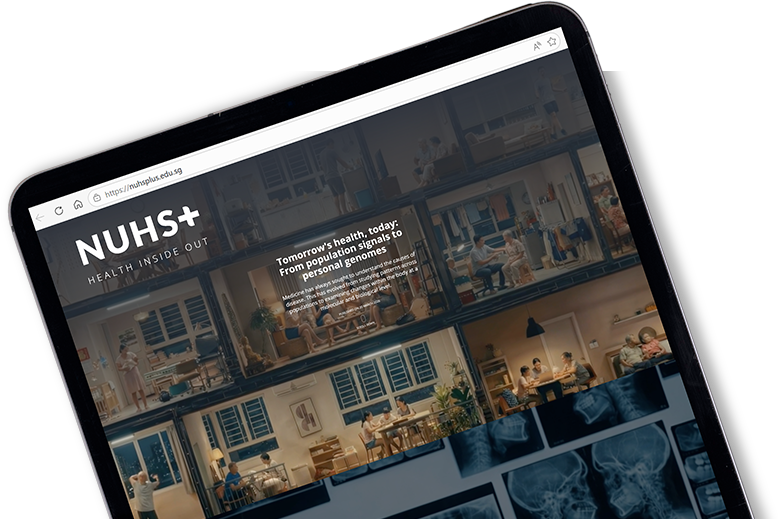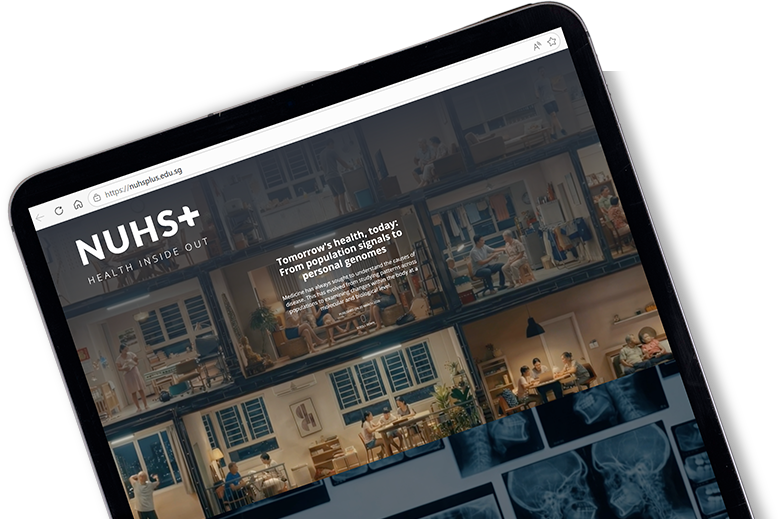
Tomorrow's health, today: From population signals to personal genomes
PUBLISHED ON
SCROLL DOWN
But the questions being asked today are more ambitious:
How early can disease be detected and how precisely can it be prevented?
Across Singapore, nearly one in three adults live with hypertension or high cholesterol. These conditions often develop quietly over decades, and become visible only after irreversible damage has begun.
At the same time, the country’s demographic profile is shifting. By 2030, almost a quarter of Singapore’s population will be aged 65 or older.
For healthcare, the implications are profound. Preventing disease can no longer begin when symptoms appear. It must begin far earlier, in patterns, signals and biological clues that emerge long before illness is diagnosed.
Across the National University Health System (NUHS), researchers are advancing precision health, linking population-level insights with the biology of individual patients
Mapping disease before it appears
"By the time disease becomes visible, it has often been progressing in the dark for too long."
- A/Prof Cynthia Chen, Saw Swee Hock School of Public Health (SSHSPH)
Predicting public health trends with data
Disease rarely emerges without warning. Long before symptoms appear, patterns begin to form — across communities, environments, and lifespans.
Through the Singapore Population Health Studies, researchers have followed individuals over decades to build one of the region’s most detailed longitudinal health datasets.
The aim is not simply to document disease, but to anticipate it based on behaviours, environments, and lifestyle factors.
“Public health has always worked with patterns,” said A/Prof Cynthia Chen.
“It helps us understand how risks vary across populations, so prevention strategies can be directed to where they are most needed.”
By modelling these trajectories, researchers can forecast how chronic conditions may evolve across entire populations. This enables screening programmes and preventive policies to be deployed with far greater precision.
But patterns alone are not enough. For prevention to succeed, insights must translate into action at the individual level.
When prevention enters daily life
“So far, we've uncovered undetected risks in 30 per cent of participants. When risks are identified earlier, care can be more predictive, more precise, and more personalised.”
– Dr Alexander Yip, Alexandra Hospital (AH).
ACTIVATION
At AH, preventive care no longer begins and ends with a clinic visit.
Through the ACTIVATION programme, wearable sensors and real-time health data now allow clinicians to detect physiological changes as they unfold in everyday life. The programme integrates behavioural sciences, lifestyle monitoring, and clinical records, generating real-time insights to shift care from episodic assessments to continuous surveillance.
At the start of the programme, the team discovered previously undetected health risks in nearly 30 per cent of participants. For Dr Alexander Yip, the results underscored how preventive care was evolving. He said, "From this perspective, medicine is moving beyond observing disease patterns to actively shaping health before clinical symptoms appear.”
Detecting infections before they spread
"When genomic surveillance lags behind evolution, critical time is lost."
– A/Prof Niranjan Nagarajan, NUS Yong Loo Lin School of Medicine (NUS Medicine)
Metagenomic Sequencing
Few challenges illustrate the urgency and importance of precision medicine more clearly than infectious diseases.
As pathogens evolve continuously, it often outpaces conventional diagnostic tools that rely on targeted tests or slow-growing cultures. To close this gap, researchers led by A/Prof Niranjan Nagarajan have turned to clinical metagenomics, which uses metagenomic sequencing to analyse the genetic material of microbes directly from patient samples.
The approach allows clinicians to detect bacteria, viruses and fungi simultaneously, and reduces diagnostic timelines from several days to around 24 hours. “When diagnosis accelerates, our ability to contain infections improves,” A/Prof Nagarajan explained.
Rapid sequencing does more than guide treatment. It also strengthens surveillance systems, allowing emerging infectious threats to be identified before outbreaks escalate.
Ageing beyond the calendar
"Beyond treating disease, geroscience helps us to understand how our bodies age at a biological level."
– Dr Fong Sheng, Ng Teng Fong General Hosptial (NTFGH)
LinAge
Unlike chronological or calendar age, which simply reflects the number of years a person has lived, biological age reflects how the body is ageing physiologically. LinAge is a clinical biological ageing clock that integrates routine laboratory tests and clinical data into a single measure of biological health and resilience. In doing so, it may reveal subtle physiological changes before any clear signs of disease appear.
As a result, two individuals of the same chronological age may have markedly different biological ages, reflecting differences in aspects such as underlying physiology and biological resilience. Early identification of accelerated biological ageing enables clinicians to intervene proactively through targeted exercise programmes, nutritional optimisation, lifestyle modification, and appropriate medical management.
In ageing societies, the implications are substantial: effective disease prevention may depend less on reacting to established illness and more on anticipating and addressing the biological processes that drive it.
Precision begins in everyday prescribing
"Antimicrobial resistance is accelerating globally. How we prescribe today directly shapes what treatments remain effective tomorrow."
– Dr Sky Koh, National University Polyclinics (NUP) and NUS Medicine
Antimicrobial Stewardship
Precision medicine does not always begin with advanced diagnostics. Sometimes, it begins with everyday clinical decisions.
To that end, NUP is transforming the way medications are prescribed through intelligent systems. Its piloted preference list customisation guides clinicians in selecting appropriate antibiotics with the right dose, duration, and frequency. This tool, which is aligned with the Ministry Of Health Agency for Care Effectiveness guidelines, achieved 86 per cent prescription accuracy for Urinary Tract Infections (UTIs).
Digital dashboards also visualise prescribing patterns in real time, and are monitored by NUP’s Antimicrobial Stewardship Programme (ASP) team. Using this data, annual deep-dive audits have been conducted across key conditions, including UTIs, acne and upper respiratory infections. These audits have identified gaps in prescribing practices in primary care, and its findings have been published to guide improvements.
The impact this has made is clear: fewer unnecessary antibiotics, a reduced risk of side effects for patients, and helping to slow the global rise of antimicrobial resistance.
The body’s overlooked signals
"Oral health is a window to systemic health."
– Dr Eunice Lua, National University Centre for Oral Health Singapore (NUCOHS) and NUS Dentistry
Detecting disease in unexpected places
Not all early signs of disease emerge in hospitals or laboratories. Some surface in less obvious places, including the mouth. Through Oral Health Research, Dr Eunice Lua and her team have examined how changes in the oral cavity reflect broader physiological changes throughout the body.
Declining oral function can affect nutrition, inflammatory pathways and metabolic health — processes closely linked to cardiovascular disease, diabetes and cognitive decline. By integrating oral screening into wider medical assessments, clinicians gain another lens for identifying systemic vulnerability earlier.
Uncovering hidden causes
"Using skin biopsy and molecular staining, we can directly visualise nerve fibre damage that other tests cannot detect."
– Dr Amanda Chan, National University Hospital (NUH) and NUS Medicine
Small Fibre Neuropathy Research
For patients with chronic unexplained pain, diagnosis can be elusive. Dr Amanda Chan’s research focuses on small fibre neuropathy, a neurological condition affecting microscopic nerve fibres that conventional diagnostic tests often miss.
Through specialised skin biopsies and molecular staining techniques, clinicians can now visualise nerve fibre damage directly, revealing mechanisms that were previously invisible. Each confirmed diagnosis offers more than relief for individual patients. It also expands medical understanding, allowing similar conditions to be recognised earlier in future cases.
The deepest layer of precision
"Genomics is transforming how we diagnose disease, predict risk and tailor treatment. At NUHS, we bring precision medicine closer to everyday care."
– A/Prof Ng Kar Hui, NUH and NUS Medicine
Genomic Medicine
At the most fundamental level of precision medicine lies the human genome — the biological code that shapes how our bodies function, develop illness and react to treatment. Across NUHS, advances in genomic medicine are bringing these once-hidden signals into everyday clinical care.
For some families, genomics today can offer answers where medicine once had none. By analysing a patient’s genetic code, clinicians can uncover the causes of unexplained or rare conditions, ending years of uncertainty and enabling more personalised care.
Genomic insights are also revealing health risks long before symptoms appear, allowing doctors to intervene earlier through monitoring, preventive treatment or lifestyle changes. For couples with hereditary conditions, genomics can guide reproductive options to reduce the risk of passing serious genetic disorders to the next generation.
At the same time, pharmacogenomics is helping clinicians tailor medications according to a patient’s genetic profile, improving treatment outcomes while reducing harmful side effects.
Together, these advances are turning genomic discovery into something deeply human — transforming science into hope for patients and families.
Looking earlier, going further
From modelling disease patterns across populations to decoding individual genomes, precision medicine is reshaping how healthcare is practised.
The goal is simple: detect disease earlier, understand it better, and intervene before it takes hold.
NUHS Scientific and Innovation Summit 2026
This April, discover how predictive, preventive and personalised care take centre stage at the NUHS Scientific and Innovation Summit 2026 — a biennial gathering of more than 600 global experts shaping the future of clinical practice.
In consultation with A/Prof Cynthia Chen, SSHSPH; A/Prof Ng Kar Hui, Senior Consultant, Division of Genetics and Metabolism, Department of Paediatrics, Khoo Teck Puat - National University Children’s Medical Institute (KTP-NUCMI), NUH and Associate Professor, Department of Paediatrics, NUS Medicine; A/Prof Niranjan Nagarajan, NUS Medicine; Dr Amanda Chan, Senior Consultant, Division of Neurology, Department of Medicine, NUH and Assistant Professor, NUS Medicine; Dr Alexander Yip, Consultant, Division of Gastroenterology and Hepatology, Department of Medicine, AH; Dr Fong Sheng, Consultant, Division of Geriatric Medicine, Department of Medicine, NTFGH; Dr Sky Koh, Family Physician, NUP and Adjunct Lecturer, NUS Medicine; and Dr Eunice Lua, Registrar, NUCOHS and Academic Fellow, NUS Dentistry.